


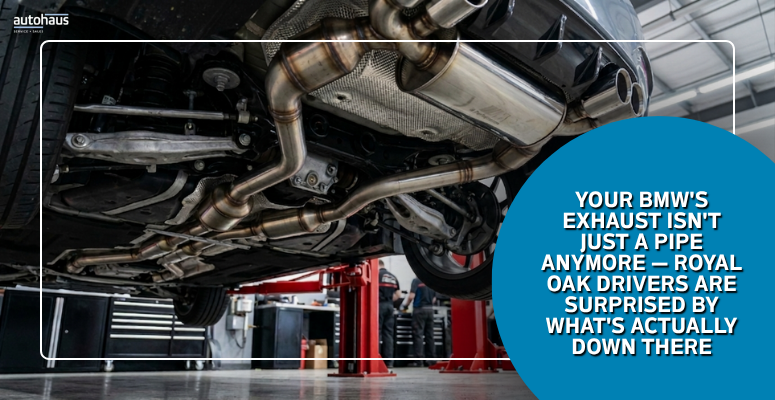
Ask most drivers what the exhaust system does and they’ll tell you it moves gases from the engine to the back of the car and keeps the cabin quiet. That’s roughly accurate for a 1985 vehicle. On a modern BMW, the exhaust system is a network of sensors, electronically controlled valves, particulate filters, catalytic converters, and actuators that interact with the engine management system in real time. When something fails — and in Michigan winters, where road salt and freeze-thaw cycles attack metal constantly — the repair often involves more than simply replacing a rusted component. Royal Oak drivers who bring their BMW to Autohaus Service and Sales get the benefit of over 50 years of German import expertise and technicians who understand these systems from factory spec down.
What Modern BMW Exhaust Systems Actually Include
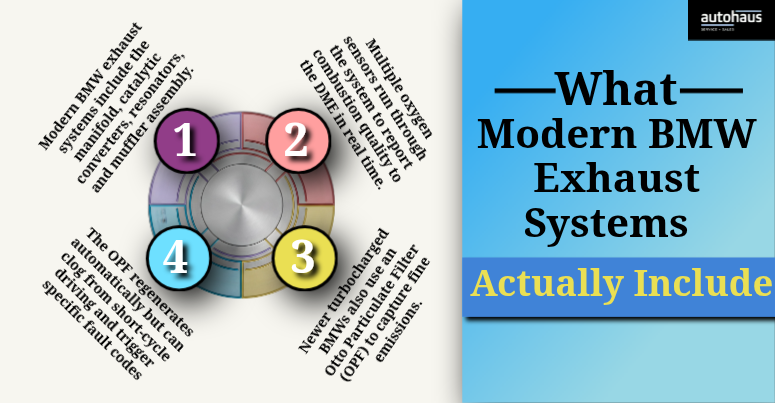
Strip away the heat shields and undercoating on a current BMW and you’ll find a system that looks nothing like a simple exhaust setup. Starting from the engine, exhaust gases flow through the exhaust manifold to one or more catalytic converters, through resonators, and then to the muffler assembly. But layered throughout that path are multiple oxygen sensors — typically two to four per exhaust bank — that report combustion quality to the DME in real time. Newer BMWs equipped with turbocharged four-cylinder engines also feature an Otto Particulate Filter (OPF), a gasoline-specific particulate filter designed to capture fine emissions. The OPF regenerates automatically but can become contaminated with short-cycle driving, and a failed OPF triggers its own set of fault codes that require specific diagnostic interpretation. Autohaus’s BMW repair service in Royal Oak covers the full scope of these systems with factory-level diagnostic equipment.
Active Exhaust Valves: Where Electronics Enter the Exhaust
BMW’s active exhaust system, available on a range of models from the 3 Series to the M cars, uses electronically controlled flap valves within the exhaust to manage both sound and backpressure. At low RPM or in comfort mode, the valves restrict flow to reduce noise. At higher RPM or in sport mode, they open to free up exhaust flow and deliver the sound the driver expects. These valves are controlled by an actuator motor and monitored by the DME — when an actuator fails, the exhaust defaults to one position, and a fault code is logged. Many shops that don’t specialize in BMW see this fault and replace components unnecessarily, or miss the actuator entirely and focus only on the mechanical side. At Autohaus, the diagnostic process traces the fault to its actual source before any parts are ordered.
Oxygen Sensors and Catalytic Converters: Why BMW Specs Matter
BMW’s DME calibration is tight, and the oxygen sensors that feed it need to match factory specifications precisely. An aftermarket sensor that works fine on a domestic vehicle may not report within the range BMW’s system expects, resulting in a check engine light even after the swap. The same applies to catalytic converters: BMW catalysts are formulated and sized specifically for the engine’s combustion characteristics, and a generic replacement often causes fitment issues, exhaust leaks, or recurring fault codes. Autohaus uses OEM-quality parts for all exhaust service work because anything less introduces problems that come back within a season — especially under Royal Oak’s road conditions, where flanges and joints are already under thermal and corrosion stress.
What Royal Oak Winters Do to BMW Exhaust Systems
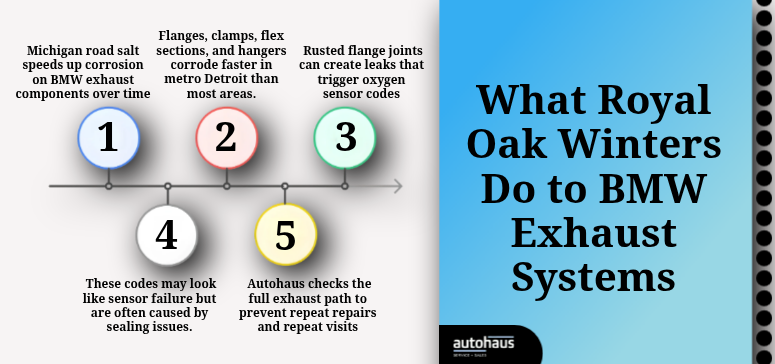
Michigan road salt is a slow-motion enemy of exhaust components. Flanges, clamps, flex sections, and hangers all corrode faster in metro Detroit than in most of the country, and a leak that starts at a rusted flange joint can throw an oxygen sensor code that looks like a sensor problem but is actually a sealing issue. Autohaus technicians check the entire exhaust path during any related diagnosis — not just the component that threw the code — because chasing a single fault without understanding the surrounding condition leads to repeat visits. If you’re hearing a rattling, ticking, or hissing from under the car, or if your BMW has a check engine light pointing at an exhaust system fault, the full services page outlines everything Autohaus handles and the schedule is easy to work around with shuttle service available.
FAQ
Why does my BMW have a check engine light related to the exhaust?
Modern BMWs have multiple oxygen sensors, active exhaust valves, and on newer models a particulate filter — any of which can generate fault codes. The light doesn’t always mean a sensor needs replacement; it could indicate an exhaust leak, a faulty actuator, a clogged OPF, or a catalytic converter issue. A proper diagnosis by a BMW specialist is the starting point.
How does an active exhaust valve work on a BMW?
The active exhaust valve is an electronically controlled flap inside the exhaust path. In comfort or low-RPM driving, it restricts exhaust flow to reduce noise. In sport mode or under hard acceleration, it opens to improve flow and increase exhaust note. When the actuator fails, the valve sticks in one position and triggers a fault code.
Can I use aftermarket parts for BMW exhaust repair?
Some aftermarket parts are acceptable, but BMW’s oxygen sensors and catalytic converters in particular need to meet tight specification ranges for the DME to function correctly. Generic replacements often cause persistent fault codes. A BMW specialist will source parts that match factory requirements and avoid repeat issues.
How often should exhaust components be inspected on a BMW in Michigan?
Annual inspection is appropriate given Michigan’s road salt exposure. Specific attention should go to flanges, flex sections, and heat shield mounting hardware, which all corrode more quickly in the metro Detroit area than in milder climates.
Royal Oak’s BMW Specialist Since 1970
Autohaus Service and Sales has been the trusted German import repair shop in Royal Oak for over five decades, with ASE-certified technicians, factory-grade diagnostic equipment, and a 24-month/24,000-mile nationwide warranty on all repairs.
📍 4411 Delemere Boulevard, Royal Oak, MI 📞 248-549-3636 🕐 Mon–Thu: 8:00 AM–5:00 PM | Fri: 8:00 AM–3:00 PM 🌐 autohaus.net